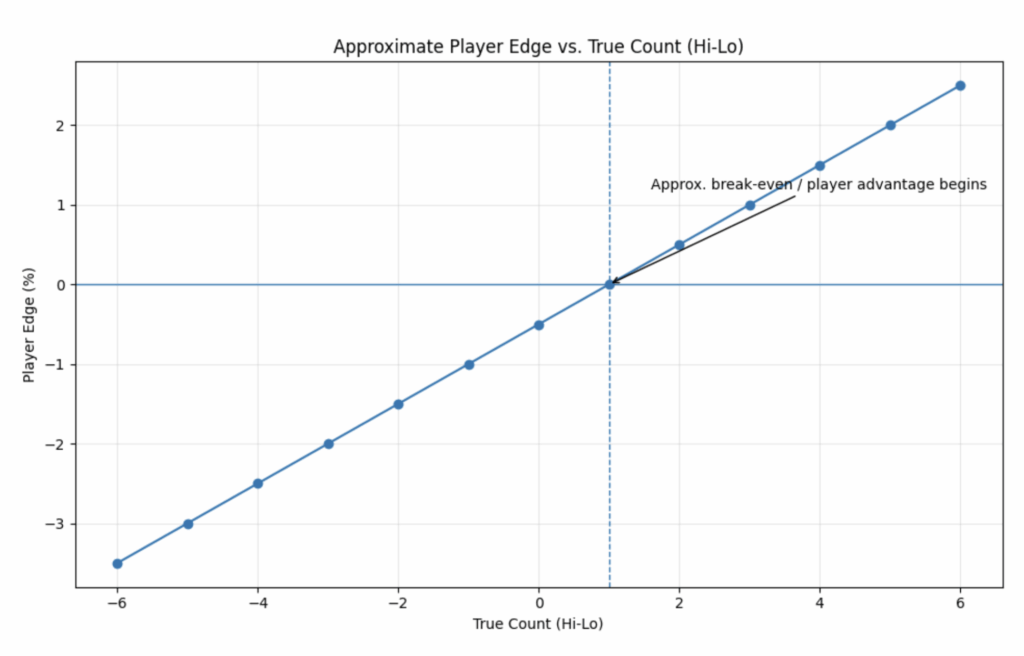
For the hi-lo card counter (or really any card counting system that involves a true count conversion), all betting decisions are based on the true count. This is because the true count gives us an indication of how the edge has changed over time. As a true count goes more negative, the casino’s edge gets larger (bad for the player!). But as the true count moves in the positive direction, the edge shifts away from the casino to the player. The higher the true count, the greater the edge. But why, how much, and what factors have an impact on the shifting advantage?
Card counting works for a three main reasons:
- When there is a surplus of 10’s and Aces left to be dealt, the player gets more blackjacks. And since blackjacks pay the player a premium of 3:2, this has a huge impact on a card counter’s edge (this is also why a card counter would typically never play a 6:5 or even money blackjack table). By betting more when valuable blackjacks will be dealt, you capitalize on getting 1.5 bets when you receive a blackjack (while only losing one bet when the dealer gets a blackjack).
- When there is a surplus of 10’s, the dealer busts more often when they have a stiff. While the player is allowed to stand on a 14, 15, or 16, the dealer must hit. With extra 10’s remaining in the shoe, the dealer will bust more often, and even if it’s a small amount, it’s enough to shift the advantage toward the player. Another way to think of this is that basic strategy works out more often and more favorably with a high true count than with a low or neutral true count.
- Finally, because of playing deviations, a card counter can further change their playing decisions to be advantageous as the composition of the shoe works out. For example, when the true count is lower, a card counter wants to hit their 12 against a dealer 2. However, when the true count gets to a true 3, it becomes a higher EV decision to stand on a player 12 against a dealer 2. This is one example of the Top 20 playing deviations we teach at Blackjack Apprenticeship.
While there are several factors that can affect it (which I’ll explain in a minute), but generally speaking, the house edge shifts by 0.5% for every true count. Since the casino typically starts with about a 0.5% edge over the player, the edge shifts towards the player around a true 1, then continues to go up about 0.5% for every increase in the true count. Just be aware that as the true count gets more negative, the casino’s edge gets larger against the player.
Of course, the worse the game, the later (and less often) card counters have the advantage. For example, on a 6:5 blackjack game, the player doesn’t get the edge until a true 3 or true 4. But on a really great game, like a double deck game where dealers stand on Soft 17’s, the player might get the advantage at a +½ true count.
As stated above, rules have a big impact… blackjack payouts, dealer standing or hitting on soft 17, what starting hands you can double down on, can you resplit Aces? Does the casino offer surrender? The number of decks also affects the house edge. The more decks, the higher the initial house edge. We have a simple house edge calculator to show you how rules and number of decks affect the house edge. (Or for a more robust version with 6:5, check out the Wizard of Odds edge calculator.)
A few other things that affect the house edge are deck penetration (the deeper the cut, the better the edge), whether you’re using playing deviations or not (using just our Top 20 deviations can boost your EV by 10-30%), and whether you’re making mistakes or not. Remember, perfection is important for card counting.
Remember that we’re talking about halves of percentages as the true count moves. A true 5, 6, or even 10 does not guarantee short term wins. It just means a slight edge for the player. But over many hours, these small advantages add up to real money over time… in the case of me and my teams, millions of dollars made with very small edges.
And because of the number of variables affecting the house edge, simply knowing that it goes up for every true count isn’t enough information to know what bets to make. Any serious card counter uses betting software that accounts for all the variables listed above, along with bankroll size, heat and risk tolerance, number of players at the table, one vs two hands being played, etc to create an optimized bet spread for the individual. Unless you don’t really care about the money you’re putting towards card counting, do not be flippant about your bet spread. Many aspiring card counters have killed their bankroll by not investing in betting software to make the correct bet spread for their situation.
We should be counting all of the cards that are removed from the shoe, that includes our cards, other player’s cards, and the dealer’s cards. Since all of those cards come out of the same shoe.
As stated in the examples above, it’s worth repeating, the easiest way to count is to wait for that second card to hit the first player’s hand, which allows you to cancel any pairs of +1 and -1. Only after that will you start counting each card individually.
There are some actions that can make counting a little trickier. Pay special attention to any double downs that get placed face down, this can also happen on split aces, which only receive one card each. Make sure you don’t forget to count these cards at the end of the round when they get turned over.