Bet Spreads for Hi-Lo Card Counting


What Is A Betting Spread?

A betting spread, or bet spread, is the amount by which a player varies their bets. In the case of card counting at blackjack, the player is varying their bet based on the true count. Betting spreads are usually expressed in a number of units. For example, if a player at a $10 table varied their bets from the minimum $10, all the way up to $100, we would say they are spreading 1 to 10

Why Card Counters Use Betting Spreads

Betting spreads are the primary method card counters use to utilize the information that comes from counting the cards. Without a betting spread, card counters wouldn’t be able to beat the game of blackjack. 

The reason bet spreads are required of the card counter is that more hands will be played at counts where the player does not have the edge than will be played at counts where the player does have the edge. Remember, we start every shoe at zero, where the house has around a 0.5% edge. 

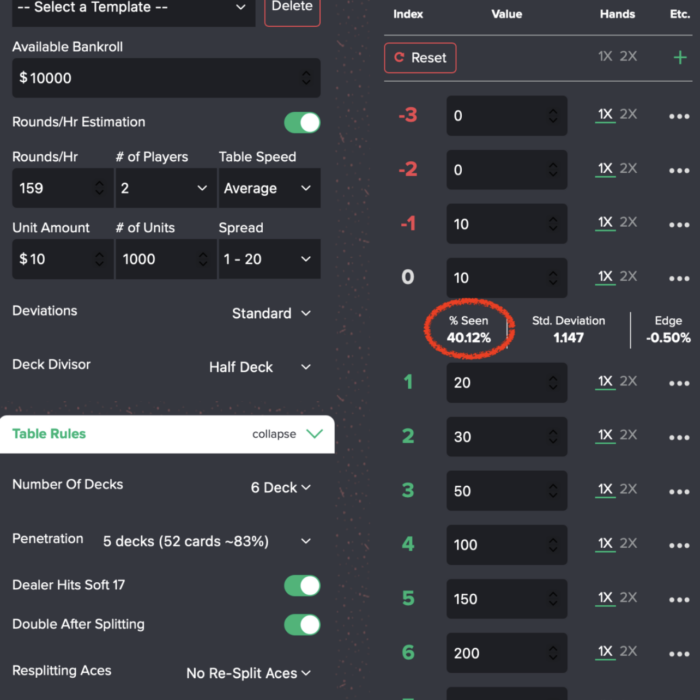
Imagine a blackjack player named Jack. Jack took the time to master counting cards, but decided he wanted to play $100 every hand, no matter what. Let’s now assume, *for the sake of example*, that Jack sees an equal distribution of positive and negative counts (although that’s not quite the case). Unfortunately for Jack, even if the negatives and positives were to balance each other out, we can find by looking at the Blackjack Apprenticeship Pro Betting Software that 40% of his hands will be played in a true zero, where the house has an edge against him.

Blackjack Pro Betting Software Edge location

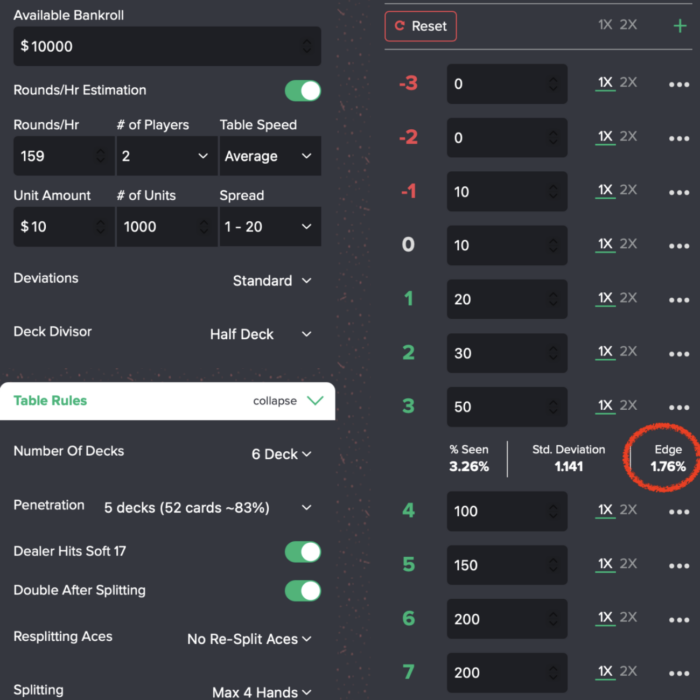
Only 30% of Jack’s bets will have a positive expected value. Further compounding Jack’s problem, the disadvantage grows with each negative true count. Even if his negative counts were equal in number, the edge against him at true -1 will be a little more than 1%, while it won’t be until true +3 that he enjoys a similar edge of just over 1% for himself. We again get these numbers from the Pro Betting Software.

Blackjack Pro Betting Software Edge location

So what does Jack need to do? He needs to bet more money in the positive true counts when they come around than he wagers in the negative and zero true counts.

How True Count, Edge and Bet Size Connect

The edge in the game shifts with every true count. As a rule of thumb, every true count is worth around 0.5%. So as the true count rises, so too does our advantage, and as our advantage rises, so too should our bets. The opposite is also true, as the true count drops, our edge goes away and our bets should drop. 

That is to stay, when we don’t have the advantage, at true zero and the negatives, we don’t want to be betting very much money, if we bet anything at all. Then we want to bet more at true +2 than at true +1, and more at true +3 than true +2 and so on. Most card counters hit their maximum around a true +6. 

Here are a few examples of what a bet spread might look like, using a $25 betting unit. 

A 1-4 betting spread might start with a $25 bet. The player would then bet $50 at true +2, go up to $75 at true +3 and max out at $100 at true +4. In negative counts, the bet will either stay at $25 or the player will exit the shoe, playing $0.

A 1-8 betting spread would similarly start with a $25 bet. The player might ramp up the same way as the 1-4 player, but simply continue up to $150 at true +5 and to $200 at true +6. 

Going a little bit bigger, a 1-12 spread would need to ramp up a little bit faster to get to that player’s maximum. Starting at $25, and then going to $50 at true +2, $100 at true +3, $150 at true +4, $200 at true +5 and $300 at true +6.

Things to Consider: Aggression, Bankroll, Risk of Ruin and Heat

Generally speaking, the larger and more “aggressive” the betting spread, the better the game will be for the player. Larger spreads result in more expected value and a shorter time to the statistical long-run. 

However, that isn’t the only consideration when we’re looking at betting spreads. We also want to make sure that our bets fit with the size of our bankroll. A betting spread for a player with a $10,000 bankroll is going to look a lot different from a betting spread for a player with a $100,000 bankroll. The same $1,000 maximum might have a risk of ruin of less than 2% for the bigger bankroll and be in excess of 20% for the smaller bankroll. Risk of ruin, is the probability of losing the entire bankroll. Not half of it, not 90% of it, all of it. So we want to be pretty cautious when it comes to managing this figure. I don’t know about you, but I’m not interested in a 20% chance of losing my bankroll, so I would size my bets a lot smaller if I were working with a $10,000 bankroll. 

The casino’s tolerance level, or ‘heat’, is the other consideration here. A bigger spread sticks out more, and draws the attention of pit bosses, surveillance, and whoever else might be in charge of game protection at the casino. That bigger spread also earns the card counter more money. A smaller spread might blend in more and draw less attention, but it will also earn the card counter less money. It’s up to the player to figure out what balance they want to aim for here, and there is no guarantee that a small spread will keep you safe from being asked to leave the casino. 

Common Mistakes

Overbetting

This is what I was alluding to in that last section. One of the biggest mistakes new card counters make is overbetting their bankroll. When a player overbets, it means they are betting far too much money for their bankroll to handle. One reason for this is overestimating the size of the player’s edge in card counting. Even at a true count of +10, using the 0.5% rule of thumb from earlier, the player would still only have a 4.5% advantage for that hand…far from a guarantee.

Another reason a player might overbet, is underestimating their risk of ruin. This is why betting software is so important to a serious card counter, and why we make our Pro Betting Software available to our Apprentice and Elite members. Along with bankroll size, every game condition can impact the risk of ruin on a given game. So it’s extremely important to know your risk of ruin for each game type, and be able to adjust your betting spread to minimize risk of ruin along the way. 

Lastly, a player might find themselves overbetting at the blackjack tables because they aren’t disciplined enough to stick to their bet spread.

Flat Betting For Too Long/Not Ramping Up Fast Enough

Sometimes players don’t ramp their bets up with the count because they’re afraid of heat, afraid of losing, or some other reason. Remember what we said earlier, betting spreads are the essence of card counting, that’s how the counter earns an advantage. 

If a card counter flat bets all the way through the shoe, the count isn’t going to help. This player will lose to the house edge over time, basic strategy and playing deviations are simply not enough to beat the game. If the card counter doesn’t ramp their bets up early enough, they might not lose their entire edge, but it will lower their expected value, raise their risk of ruin, and lengthen the long-run. Imagine a player doesn’t raise their bet at true +2, well depending on the game conditions, that’s around 6% of all hands, and is a much more common situation than the higher true counts. Our edge might be bigger in the higher true counts, but we make a lot more of our money in the lower true counts like true +2 and true +3, simply because they are so much more common. If the player isn’t betting into these counts, they’re losing a significant portion of their expected value.

Copying Someone Else’s Spread

A player without betting software might think they can just copy a spread they saw on the internet, or that they saw another player using at their local casino. What’s wrong with this is that the example spread they are copying isn’t formulated for their bankroll, and probably isn’t for the exact same game circumstances they are playing. It doesn’t account for the player’s goals with card counting. At the end of the day, the player who is just copying another spread, has no idea what their risk of ruin is or what they can expect to earn from that spread. They might be playing for $2/hr with a risk of ruin north of 50% for all they know. 

Game Rules and Penetration Matter Too

The EV and Risk of Ruin of a game will also be impacted by the quality of the game you’re playing. To make the point, let’s look at a couple of extreme games using the spreads we mentioned earlier. The 1-4, the 1-8 and the 1-12. 

For the first game, let’s look at a 6 deck game, with an amazing ruleset. The dealer stands on soft 17, late surrender is allowed, you can double down after splitting, double down on any two cards and re-split your aces. Of course, blackjacks also pay 3 to 2. At this hypothetical game, let’s say the dealer deals down to one deck remaining. We will use a $20,000 bankroll for the sake of example. 

Under these conditions, the 1-4 bet spread from earlier the player has an expectation around $40/hr and a risk of ruin around 2.5%. The 1-8 spread results in an expectation of nearly $70/hr and an even lower Risk of Ruin that dips below 2%. Our 1-12 raises the expectation over $100/hr, but also raises our risk to a number over 3%. 

Now let’s look at a second 6 deck game, this time we’ll take away the amazing ruleset and make the penetration worse. The dealer hits soft 17, late surrender is not allowed, no double after split is allowed, you can still double any two cards, but you cannot re-split your aces. Blackjacks still pay 3 to 2. This time the dealer shuffles with one and a half decks remaining. 

Under these conditions, the 1-4 spread simply isn’t enough to beat the game. The player expects to lose $10/hr, and since the game is negative, the risk of ruin is 100%. Our 1-8 starts to tip the game into the player’s favor, but not by much. The player can expect to earn around $3.50/hr with a risk of ruin north of 70%…yikes! The 1-12 makes things a little better, but it’s still pretty ugly, now we’re looking at a little less than $25/hr and a risk of ruin that’s still north of 30%. 

You see how much the conditions of a game change things, we can’t just use the same spread from game to game. 

Where You Should Get Your Numbers From

The variability of game conditions, individual bankroll sizes and even risk tolerance means that we can’t give you a one size fits all answer to what your betting spread should look like. 

Never fear though, there are a few ways to figure things out. The numbers in this article, and the numbers I and the other pros use, come from the Blackjack Apprenticeship Pro Betting Software. Where billions of hands have simulated under the selected conditions to get an accurate estimate on expected value and risk of ruin. Of course, we think it’s the best way to do this, but it isn’t the only way. 

If you’re comfortable with the math, you can estimate your expected value per hour by hand, and you can use the Kelly criterion to manage risk. The Kelly criterion is a formula that’s used to manage risk and optimize capital growth over time. 

If you don’t want to use the software yourself, and don’t want to do the math yourself, then the next best thing would be to receive bankroll coaching from a professional who does have access to betting software and let them guide your betting spread strategies. 

At the end of the day, it’s important to use a reliable method to estimate your expected results and how much risk you’re taking on. Guessing at the numbers or playing blind is a recipe for disaster. Early in my card counting journey, I tried to guess at these things. Only after getting betting software and running a simulation for the first time, did I realize I was playing a game worth $1/hr with a risk of ruin north of 50%. If I had never used betting software, I would’ve never made meaningful progress in bankroll growth.