Welcome Guest   Log in

For those who still don’t know why to Count Cards

September 22nd, 2009

I received this email last week, and thought I’d use it as an opportunity to break it down for those wondering “why do you keep a count of the cards“: Continue reading “For those who still don’t know why to Count Cards” »

How to Practice Blackjack Pt. II

April 20th, 2009

In Part I, I talked about Basic Strategy being the foundation of being a card counter. I want to emphasize that you should continue to keep going through all the basic strategy decisions regularly. Just recite the entire chart from memory in the car once a day, and you won’t find yourself at the casino in the middle of a big hand wondering, “does A,7 hit or stand against 9?”.

In this post, I’m going to talk about practicing counting cards. Ben gives a thorough explanation in one of our videos. But I’m going to give a few tips.

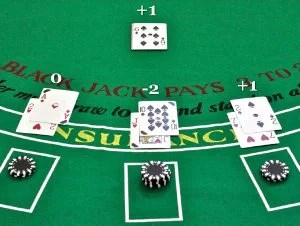
1. The obvious first step is to take a deck of cards and count through it, one at a time. If you don’t end up at zero, then you did something wrong. This will help you in creating new associations with cards. When you’re playing at a table, you want to see a 4 of clubs primarily as “+1″, not as a 4 of clubs. After time, you’ll start to see cards simply as +1, 0, or -1.

2. Have an approach to cancel that is foolproof. I see lots of rookie card counters trying to get too fancy with cancellations at the table. They wait until all the cards are out on the table, and are cancelling a 10 on one side of the table with a 2 on the other side. This is going to result in problems sooner or later. So have a method that you do the same every time, and that leaves no room for error.

3. Practice by going into a casino and standing behind the table, and just watching. If you can get thru an entire shoe without dropping the count, missing a card, or getting mentally fatigued, then you’ll have a better time when you’re actually trying to play while counting.

4. Buy CVBJ. This software will tell you when you’re off on the count, and so much more.

Remember that being a 99% accurate card counter won’t cut it. But a 100% accurate card counter can turn the tables on the casino!

In part III, I’ll talk about practicing true count conversions.

How to Practice Blackjack pt. I

April 10th, 2009

Study Habits

So a lot of people have been asking for tips on how to practice blackjack, so I’m going to start a blog series about what I’ve learned about training:

PART I:

Basic Strategy is the Foundation

A lot of people say, “I know about 95% of basic strategy. Show me the deviations, get me to a table, show me how to bet! I’m ready to have at it!” But if you are still either making Basic Strategy mistakes, or having to use large amounts of mental energy to make BS decisions, then you’re in trouble! I don’t care how well you can count and how many deviations you memorize… if you make Basic Strategy mistakes, you’ve just killed any potential advantage you could have over the casino.

And even if you don’t make mistakes, if there are situations that arise where you have to put mental energy into remembering the correct decision, you will have a really hard time adding the other elements: counting, deviations, betting decisions, etc.  If, however, for every playing decision, the correct Basic Strategy answer comes instantly, and without energy, then keeping a running count, converting it to true count, and referencing deviations and bet decisions will be MUCH easier.

Ok. So how do I get better at Basic Strategy quickly?

1. I recommend talking through the entire chart every day, a few times a day. Start with Splits, and say “Aces always split. 10′s never split. 9′s split up thru 9, except against a 7.” etc. You should be able to effortlessly run thru the chart.

2. Make flash cards. Put every situation on a card, like “A,7 v. 2″ on one side, then the correct decision on the other side. There will be lots of decisions that are so easy, you can start removing them from the stack of cards, and before long, there will only be the 10-20 toughest decisions in the stack. Keep reviewing them until you don’t have to think thru the whole chart to access individual decisions.

3. Play Basic Strategy. Buy CVBJ or use an iPhone App (we have one we’re finishing up). Drill yourself on basic strategy decisions. Until you can play Basic Strategy perfectly, you shouldn’t get obsessed with counting or deviations.

4. Keep reviewing. Basic Strategy is sort of an abstract thing. So you won’t retain it if you don’t keep practicing and reviewing it. You might go 10 hours of playing blackjack without seeing some decisions. But when you DO see it, you want to know what to do instantly.

Bringing down the house since 2003,

Colin

How much does Penetration really matter?

September 12th, 2008

I recently received this question from a member of our website:

“hey can you explain the importance of deck penetration and if there is any change in strategy for different penetration. Thanks, love the site!”

ColinMember, thanks for asking, because penetration is incredibly important. First off, I’m going to assume that we’re all mature enough to avoid the jokes pertaining to the obvious sexual innuendo regarding “penetration”. In the world of blackjack, “penetration”, or “deck penetration”, is regarding to the amount of cards that the dealer cuts off, relative to the cards dealt out. In the first several months of card counting I gave no attention to deck penetration. I paid attention to the rules and the table minimum. That was it. Then, after reading “Burning the Tables in Las Vegas” by Ian Andersen, I realized that I should try to find games with better penetration. But it was still probably the third or fourth most important factor in my mind.

As I’ve gotten more familiar with the math of the game, and as I have spent more time with simulation software, I’ve realized that deck penetration is drastically undervalued. People think that the main ways to make more money at card counting are to bet more and to play games with better rules.  Did you know that you can add much more value by finding a game with 10% better penetration than by betting 10% more on high counts. Let’s say you’re using a 1-10 bet spread. Now, on a typical game, you’d add around 10-15% to your EV by betting 10% more on all positive true counts. On that same game, if you get 10% better penetration, you’re going to add 40-60% to your EV.

Cutting the DeckAnd that’s not where the benefits end with improved Penetration. The fewer cards that they cut off, the more of a sure thing that game becomes. One of the reasons I don’t play games with poor penetration is because it would take so many hours to overcome variance, it’s not worth the risk.  However, as the penetration gets better, the number of hours necessary to reach the “long run” becomes less and less. I typically won’t touch a six deck shoe game with more than 2 decks cut off.

So next time you head out to a casino, pay careful attention to how many cards they cut off the back of the shoe before dealing out the deck. It often varies from dealer to dealer, so stick to those dealers that offer better penetration. It’ll take fewer hours to guarantee a profit, and your $/hr will skyrocket!

The Big Player and playing the part: Story Time!

August 20th, 2008

ColinLet me tell you about the first time I was the Big Player.

I was pretty excited to be the one throwing down thousands of dollars. So before going in to the casino, I started thinking, ” What’s my story going to be?”

So, before entering the casino, I decided to borrow the story of a friend of mine: guitar player in a rock band. A long time friend had recently gotten his band, The Taking*, signed to a major record label deal, and got a large signing bonus in the process. So, young white kids probably all look the same to Casino Pit Bosses, I assumed I could say that I was guitar player for The Taking, and just got a six-figure signing bonus from the record label. Then, if they looked it up online, they’d see that it was a legitimate band, and it would explain why I was throwing around money like it was no object.

RockstarWe enter the casino, and the Big Player act is working perfectly. I’m actually playing next to professional athletes, betting much more than they are, and everyone loves me! I’m up a ton and things couldn’t be better. After several hours, a Pit Boss says to me, “So, you’re in a band, huh?” Even though I couldn’t remember telling my story to anyone yet, I decide to go with it. I say, “Yeah. I play guitar.” I’m just about to go into my story about how “The Taking” just got signed, blah, blah, blah when the Pit Boss replies, “Rocketeer*, right?” My mouth drops and I start to panic, because Rocketeer actually WAS a band that I played guitar and sang for a couple years before. Not a famous band that makes tons of money, but a poor, obscure, short lived band with no website, a 20 person fanbase, and no Major Record deal. Oh no! My cover’s blown. They’ve even figured out the band I used to play in! This is bad.

I had no option but to go with it. So, mustering up false confidence, I say, “Oh yeah. You’ve heard of us?”

A couple hours later, we decide to call it a night. We meet up in the hotel, and Ben says, “So, did you like that story I told the pit boss about you?” It turns out that Ben was playing at a table, spotting for me, and he said to the pit boss, “I recognize that guy. I think he’s the lead singer of Rocketeer!” Since Ben knew about the band I used to be in, he thought it’d be funny if word got back to me that I was famous from the short lived band. The moral of the story is, if you work out an ingenious story as Big Player, make sure the spotters know your story too, so they don’t contradict yours at the tables. Or if your spotters are as witty and mischievous as Ben, be prepared to think on your toes.

*Note: Band names have been changed to protect the innocent and guilty.

You Can’t Make Money Counting Cards?

July 7th, 2008

Then ask me how I pay my mortgage! We were  sent the above clip from this morning talk show in San Deigo on Youtube where a guy, Oliver Galang, is pushing his book entitled “Card Counting: the real truth in Blackjack.”  

undefinedColin’s Response

  • Oliver main argument is that the reason you CANNOT win over the long haul in blackjack is because the dealer has the same chance of getting 20 or 21 as you. Good point, Oliver. However, did you forget that the player gets paid 3:2 on blackjacks (21 with the first 2 cards)? So it’s an even trade with the dealer for 20′s and multiple card 21′s, but you’re getting 50% more for every blackjack that you get than the dealer. I’ll trade an even number of $100 blackjacks back and forth between me and the dealer all day, because I know that I get $150 for each blackjack, while the dealer only gets my $10.
  • Oliver’s second argument is that HE lost everything. Well, sorry Oliver that you aren’t capable enough, but don’t claim that it can’t be done just because you are inept. Plenty of people “count cards”, but don’t make a profit, for any of a number of reasons… They either do not follow the strategy perfectly, cannot count perfectly, don’t have a winning bet spread, cannot manage their money properly, tip away any advantage they do have, or play unbeatable games. Whatever the case may be, I guarantee that Oliver had too much gamble in him to be a successful card counter.
  • The main casino he mentions is Barona, in San Diego. I must know 30+ card counters who have played Barona (myself included), and we’ve all been backed off from blackjack sooner or later (usually sooner). Barona even has a Blackjack Hall of Fame! They know a successful card counter when they see one. If Oliver was at all apt, he wouldn’t have lasted long at all at Barona. Yet another reason why his problems are with his own Blackjack game, not Card Counting as a science. Sorry Oliver, but you’re like a gunman with horrible aim claiming that guns can’t kill people.
  • Oliver claims he invented the “double up theory”, where you double your bet after you lose a bet, as to win back your original money and always end up even or on top. This is actually called a “progressive bet spread” or “Martingale bet system”, and it’s as old as gambling. I first heard of a progressive bet spread in college in regards to how to beat roulette. This was long before I ever had gambled or knew how to count cards. I don’t need to explain why it’s faulty logic. If you’re interested you can read it here . But I don’t know what’s more asinine: Oliver claiming he invented it, or that he uses it.
  • My final area of amusement from the interview is that Oliver says that he still gambles. After he “lost it all” gambling, he still is either dumb enough or addicted enough that he’s still out there donating his money to the casinos. If you’re going to write a book about the dangers of gambling and how you lost it all, at least don’t be stupid enough to admit you’re still caught up in gambling.
  • So here’s my conclusion: Oliver is yet another gambler making excuses for their lack of self-control and addictive habits. And he’s using his tragedy as an opportunity to make a buck selling a book about it, cashing in on the brief media hype caused by the movie “21″. He can’t admit that he’s too poor at card counting to make it work; he has to say that card counting itself is flawed. Well, that comes as a surprise to myself and all the other advantage players that are able to consistently make a living (or at least supplement their income) from card counting.Oh well… at least might keep a few ploppies from wasting their money at the blackjack tables.

    Ben Ben’s Response:

    This guy is a tool. “Streak theory”?!?! Common. Streak theory was disproved back when Euclid invented math  2200 years ago. So let’s try and figure out what this guy is saying. He lost all of his money so card counting doesn’t work. Hmmmm….let’s think about this for a second. Maybe, instead of jumping the gun hear and ruling out all the rules of math and logic for the last 4 decades,  there’s another option we can consider: This guys is a ***insert expletive***tard.  Let’s look at the clues:

    1. He went bankrupt from gambling, thinks it doesn’t work….AND IS STILL DOING IT!. Go Winner!
    2. Borona let’s him play there. For those of you who do not know Borona is one of the more savvy joints out there for a couple of reasons. They actually take time to assess people’s play before kicking them out…And they don’t view card counting as a crime and actually treat you with respect  as they ask you not to take any more of their hard earned money. If you’re there you can actually check out their card counters hall of fame. Anyways, back to the topic. I was kicked out of Borona 3 hours and 13 grand later but for some reason they have decided that this guy is not a threat?! Hmmm…
    3. Let’s be honest here. He seems like a retard (“Uh..you will get a 20 or 21 at a 16 count but so will the dealer”). For those of you who do not understand this idea anyone that has heard me teach on blackjack gets this concept in the first 15 minutes. High count = high cards = more blackjacks for everybody BUT when a player gets a bj they get 150% and when a dealer get’s it they only get 100%. So..DO NOT BUY THIS BOOK or be retarded like this guy. I want to show this video at our next bootcamp and tear this guy a new one just to make sure that not one buys into this.

    ps. For all of you who do understand math and logic please do not email me telling me that Euclid did not really invent math. it was a figure of speech.

    PPs. BUT he is credited with most of what we consider modern geometry.

    Shoes, Shuffles, and Shoddy Machines

    July 7th, 2008

    A lot of people ask me if shoe games (4, 6, 8 deck) can be beaten by card counting. Also, what are the advantages/disadvantages of casino shuffle machines compared to dealer shuffles. As is usually the case with professional Blackjack, it can be a complex answer. But here’s the rundown.

    The Shoe

    Shoe games are completely beatable by card counting. The increased number of decks DOES decrease the advantage of the game. But that is often counterbalanced by other factors like better rules or sometimes really great penetration (the number of cards cut off before the shuffle). If you are using a count that converts to a true count, you can still play a great winning game at 6 and 8 decks. The rule of thumb is, if everything else is the same, the game with the fewest decks is the best. But be aware of the other situations like rules, number of players at the table, and penetration.Many casinos still use a hand shuffle. There is nothing to fear about a hand shuffle. Dealer’s aren’t shuffling in a way that cheats the player. They are just following a pattern that the casino has trained them to use that will cause a “random” shuffle for the next shoe. The downside to the hand shuffle is that it takes time, slowing the game down. The upside to the hand shuffle is that, if you’ve mastered shuffle tracking, and the casino has a trackable shuffle, you can sometimes exploit the hand shuffle. But finding trackable shuffles is rare these days.

    Random Shuffle Machines

    There are 2 types of shuffle machines. The first of which is a random shuffle machine that takes all the cards (i.e. all 6 decks or 8 decks) and shuffles them together. Then the dealer takes the full stack of cards, has a player cut, and puts it into a shoe and deals. These shuffle machines are great. They speed up the game and having nothing that a player should fear. The only downside is that you cannot shuffle track a game that is not hand shuffled.


    Continual Shuffle Machines (CSM’s)

      The second type of shuffle machine is the CSM. If a dealer deals out 1-4 rounds, then takes the used cards and puts them into a machine that he is continually taking cards out of, then he is using a CSM. These machines continually shuffle together 3-5 decks, making it impossible to predict what types of cards are left in the shoe. Thus, it’s impossible to count a CSM game. Some people panic that all casinos will start using them, and card counting will be a thing of the past. However, they’ve been around for quite a while, but still haven’t caught on. I was in a casino recently, and they had about 30 blackjack tables, of which 4 had CSM’s. The casino was packed, but the CSM tables were empty. Players just don’t like them. Plus, they’re expensive for casinos to have and break down a lot. So I don’t see them taking over.Hopefully this clears up what shuffles and number of decks to play and not play when counting in the casino. You know what, even if you’re not counting, don’t play CSM games, because we just don’t want to encourage them in the casino!

    Efficiency vs. Proficiency

    April 7th, 2008

    ColinI hate traffic. I will do almost anything to avoid driving in traffic. If I HAVE to drive during rush hour, I try to bring my infant son with me so I can use the HOV (high occupancy vehicle) lane to bypass getting stuck in the slow lanes. I just can’t understand spending an hour getting somewhere when I can be strategic about what time I drive, or finding a legal way to use the HOV lane, so I can get to the same place in half an hour. It’s just a way to get double the return on my time. It’s the same thing as picking a checkout line with no one in it at the grocery store, or looking for the gas station pump with the fewest cars lined up for it.

    I view everything this way. And I believe what has made me obsessed with this idea is card counting. I see advantage card counters pay no attention to the choices they make concerning playing conditions, and it drives me nuts. When I walk into a casino, I’m not there for social interaction; I’m there to make money. Every decision I make is based on that concept. If I walk into a casino and have an option between a table with 4 people playing at it and another table that has no one playing at it, I know I can play twice as many hands in an hour with just me and the dealer. If there’s two identical tables, one with a fast dealer and the other with a slow dealer, I’ll pick the fast dealer (because odds are I’m waiting on the dealer much more than they are waiting on me). If I have the option between a game with 8 decks and average rules, or 6 decks with better rules, it’s a no-brainer. I’m not going to work twice as hard to make the same amount of money. I’m going to be strategic about the conditions I chose.

    A lot of newbie card counters think the best way to make more money at it is to learn an incredibly complex card counting system. But consider this: if you can play a complex system that generates an extra 20% higher $/hr, but I can play a simpler system for 50% more hands/hr, I’m going to make much more money than you. But I better go. I have to run some errands before the afternoon rush hour.