When counting cards in blackjack, your true count is the count normalized to a per deck number.

When counting cards in blackjack, your true count is the count normalized to a per deck number.
In multideck games, simply keeping a running count isn’t enough for us to beat the game. In a balanced card counting system like hi-lo, we need to figure out what our count is per deck remaining. Our running count by itself doesn’t tell us enough about the remaining cards to be dealt unless we convert that number to a true count.
Think of it this way, if we have a single deck of cards and we remove a 5, we have a running +1 and already have the advantage in the game. But what happens if we remove just one 5 from an eight deck game? It’s good for the player, but it’s not enough to give the player the edge. You would need to remove eight 5s from the shoe to have a similar effect to removing a single 5 from the single deck game.
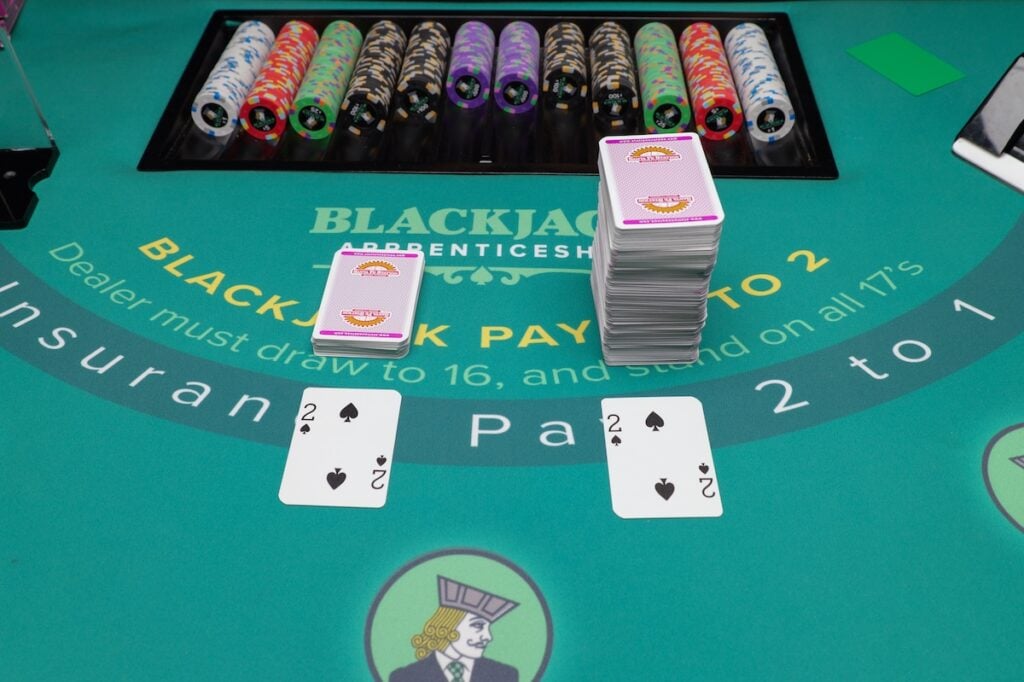
This is because quite simply, there are more cards in the eight deck game. In the single deck example, that 5 is one out of fifty-two cards. In the eight deck example, that 5 is just one out of 416 cards.
In order to convert your running count into a true count, you will simply divide your running count by the number of decks remaining to be dealt.
For example, if you are playing a six deck game and you have a running count of +6 after the first hand. You would divide your +6, by the number of decks remaining, 6, to get a true count of +1.

One more example, you’re playing a six deck game. You have a running count of +9 halfway through the shoe, so you divide your +9 by 3, which gives you a true count of +3.
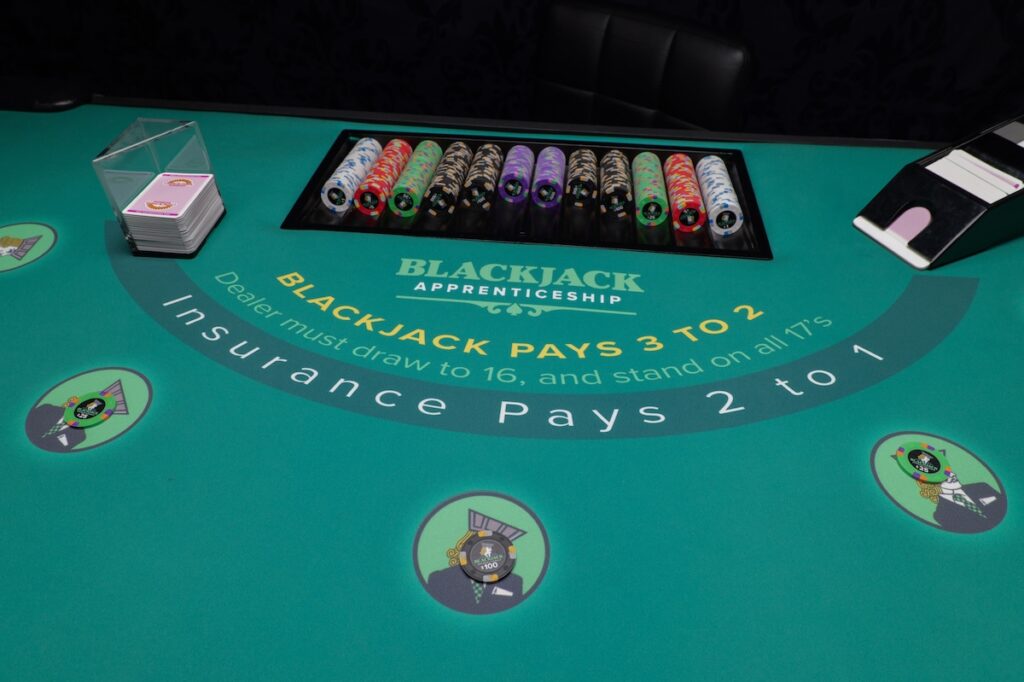
Put simply, we want to use the cards in the discard tray to estimate how many decks are remaining to be dealt. Let’s say we’re playing a six deck game and there is one deck worth of cards in the discard tray, we would have five decks remaining to be dealt. Once there are two decks in the discard tray, there are four decks remaining and so on and so forth.
Whenever you have a decimal, simply truncate, or scrap, the decimal and use the whole number. Let’s say you have a running +5 divided by two decks remaining for a true 2.5, simply get rid of the 0.5 and call it true +2. This is also why penetration matters, the deeper the shoe goes, the more important precise deck estimation becomes.
Most beginners will start by using full deck divisors in their true count conversion. This means for them, when they see more than two decks in the discard tray, but less than three decks, they will round down and say there are two decks in the tray. This player would divide their running count by four (assuming we’re playing a six deck game) to get their true count.
Some card counters go the extra mile and get good at estimating to the half deck, of course this also means dividing by decimals. In the example above, this card counter would say there are two and a half decks in the discard tray, and would divide by three and a half instead of by four.
Let’s use that same situation, there’s around 3.5 decks remaining to be dealt, and we have a running count of +7. The player using full deck divisors would divide their +7 by 4, they will have a true +1 after truncating the decimal. The player using half deck divisors would divide their +7 by 3.5, which would give them a true +2 exactly.
Generally speaking, a beginner would be well served to keep things simple with full deck estimation, and truncating the decimals. This serves to make the arithmetic easier, you can forget about tricky decimals and just worry about whether you have hit a critical threshold rather than trying to estimate to the exact number of cards, or calculating the exact decimal. This is especially true when talking about multi-deck shoes, typically six or eight decks. As you get more comfortable with all the steps involved in card counting proficiently, you might decide to add half deck divisors to your skillset.
A; We are playing a six deck game. There are four decks in the discard tray. Our running count is +11, what is our true count?
B: We are playing a six deck game. There are two decks in the discard tray. Our running count is -8, what is our true count?
C: We are playing an eight deck game. There is one deck in the discard tray. Our running count is +12, what is our true count?
D: We are playing an eight deck game. There are three decks in the discard tray. Our running count is +16, what is our true count?
E: We are playing a four deck game. There are three decks in the discard tray. Our running count is +4, what is our true count?
Try using a half deck divisor for this last one.
F: We are playing a two deck game. There is half a deck in the discard tray. Our running count is +3, what is our true count?
Answers (highlight to view): A. +5 B. -2 C. +1 D. +3 E. +4 F. +2
How did you do?
Using the wrong divisor can happen for a few different reasons. One of the most common ways this unfortunate error can occur is when a player conflates the decks in the discard tray with the decks remaining in the shoe. While practicing, it’s a good idea to get into the habit of stating the divisor in your true count conversion. For example, a running +12 with four decks remaining would be “12, 4, 3” in your head, to drill the correct divisor into your head at any given time.
Another reason this can happen is a misunderstanding about the number of decks remaining. We often get asked if the cut card changes your starting divisor, it does not. All of the cards are shuffled together, whether they get put behind the cut card or not. If you’re playing a six deck game, you will always start with a divisor of six, no matter how many cards are cut out of play.
This is a very specific way that the wrong divisor might get used. The solution to this one is simply doing a lot of practice. One way I like to practice deck estimation is by practicing with real cards from a casino, you can often get used cards at casino gift shops for cheap. Some of it will come with just basic card counting practice and checking your deck estimation at different junctures. What I encourage new players to do, is to leave stacks of cards in different places around the house, so that you’ll get used to what two decks, one deck, four decks, etc. look like.
Some players become dependent on using the empty space in their discard tray at home or at their local casino, for deck estimation. Unfortunately, this doesn’t train the skill we actually need, which is being able to estimate the cards themselves. Not all discard trays are created equal, discard trays vary in height. In fact, some casinos might use an eight deck tray for a six deck game, or even a double deck game. Sometimes you might even find a casino that uses a smaller discard tray that doesn’t even fit all of the cards.
We’re just doing division here, and even simpler than that, you can just ignore the decimal. There’s no need to make it any more complicated than this. Sometimes players get a little too fine with their true count conversion and try to get an exact true count to the decimal.
While it’s tempting to try and be as accurate as you can be, fractional true counts don’t really do us a whole lot of good. Card counters for decades have succeeded with the simpler approach of just dropping the decimal, all of the software that simulates card counting strategies, has done so with the dropping of the decimal. Simplifying the process is plenty to beat the game.
What tends to come from overcomplicating things, is the slowing down of one’s counting process, which often creates even more counting mistakes at the table in an attempt to catch-up with the action.
If you’re someone who struggles with division. One thing that can help simplify the process is simple ‘skip counting’. Let’s say you have a running count of +17 and a divisor of three. You can simply count by threes to get your true count. In your internal monologue, “3, 6, 9, 12, 15…” we stop at 15 since our next one takes us past our running count. We counted five times that three goes into our +17, our true count is +5.
We have separate articles dedicated to discussing this in more detail. For now though, here’s what you need to know.
As the true count rises, so too should a card counter’s bets. The house edge or player’s edge is directly related to the true count, so a card counter wants to raise their bets into more advantageous situations.
Card counters will also make changes to their playing strategy based on the true count, these are what we call playing deviations. Here’s one example, basic strategy says to never take insurance, but if you’re counting cards, it becomes profitable to take insurance with a true count of +3 or higher.
Of course, BJA members can use the true count drill in our training suite. But you can also do a lot of practice at home. While dealing to yourself, between rounds, stop and estimate how many decks are remaining, and calculate your true count. You can double-check your deck estimation by counting out the number of cards in the discard tray to see how close you were.
As was mentioned in an earlier section, you can stack up different numbers of decks and keep them in view in order to familiarize yourself with what each number of decks, one through eight, looks like in a stack.
It’s also not a bad idea to work on doing division quickly, just like you’re back in elementary school. The more division you do for true count conversions, the more you’ll begin to memorize which running count means which true count at different points in the shoe.
Once you’ve mastered true count conversion, you’ll need to understand what to do with that number. Read our article on betting spreads to learn more about how to use the true count to vary your bets and gain the edge over the house.